condit 2012 1
FRIDAY 10 FEBRUARY 22 hs.
This is my condition (U.S.)
This Is My Condition is a one man band, in which Craig Comstock plays guitar, drums and sing simultaneously. In the tradition of noise rock, their music is heavy, strong and intense, and both very open and [...]
FRIDAY 10 FEBRUARY 22 hs.
|
This is my condition (U.S.) This Is My Condition is a one man band, in which Craig Comstock plays guitar, drums and sing simultaneously. In the tradition of noise rock, their music is heavy, strong and intense, and both very open and unstructured. Ignacio Parodi (musicalization)
Kathryn Trigg + Natalia Tencer – (Dance) “An Adagio” ————————– COSO Set for Guitar Noise, low, battery and samples of live video shot. ————————– |
The study Beccar Varela BVW Werber shared future reforms cello edilicias, first experimental arts center in Buenos Aires Technology District.
FestEco will be the first festival "zero carbon" in Argentina. The objective is to generate awareness delfestival our carbon footprint in a creative and fun, through art, projections, a stage with music and theater, a fair, information booths, workshops, activities for children, a green room, games on [...]
FestEco will be the first festival "zero carbon" in Argentina. The objective is to generate awareness delfestival our carbon footprint in a creative and fun, through art, projections, a stage with music and theater, a fair, information booths, workshops, activities for children, a green room, games on the carbon footprint and more.
All this, using alternative energy, part of which will be generated on the fly with audience participation. There will also be a tree planting in the neighborhood. To achieve this, ambientateargentina.com together with many organizations. Work with them through their project ideame.me
In the coming days will be ready one of the modules to interact with the installation. This is a Kinect and to navigate the virtual environment through body gestures.
Also re-paint the wall of gray paint for projection and put a slightly improved version [...]
In the coming days will be ready one of the modules to interact with the installation. This is a Kinect and to navigate the virtual environment through body gestures.
The Flash Player and a browser with Javascript support are needed.
Also re-paint the wall projection of gray paint and put on a slightly improved version of the program.
Next on the agenda is to add more images and information.
SERGIO GOODS [ Argentina ] CILANTRO DUO [ austria + Mexico ]
Condit's second concert is dedicated to post-noise and acoustic and electronic improvisation, with the presentation of Sergio Merce and the first concert of the Duo Argentina Cilantro (Billy Roisz [Austria] and Angelica Castello [Mexico]).

SERGIO GOODS [ Argentina ] CILANTRO DUO [ austria + Mexico ]
Condit's second concert is dedicated to post-noise and acoustic and electronic improvisation, with the presentation of Sergio Merce and the first concert of the Duo Argentina Cilantro (Billy Roisz [Austria] and Angelica Castello [Mexico]).
An excellent opportunity to learn about the historical museum of the College founded by Rosario Vera Bernasconi. Chela very special invitation recommended.
Playful, inclusive and historically seductive, Bernasconi Museum participates in a new edition of Night of the Museums unusually innovative proposals combining traditional with their collections.
An excellent opportunity to learn about the historical museum of the College founded by Rosario Vera Bernasconi. Chela very special invitation recommended.
Playful, inclusive and historically seductive, elBernasconi Museum participates in a new edition of Night of the Museums unusually innovative proposals combining traditional with their collections.
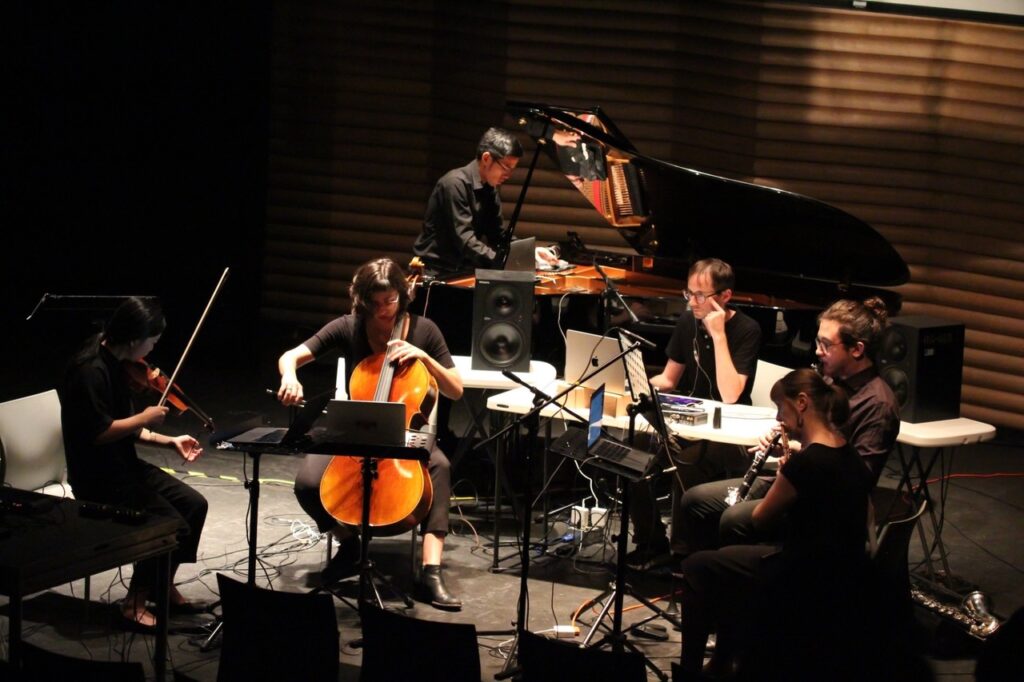
conDiT [concerts in Buenos Aires Technology District] is a series of concerts performed on the cello (Latin American Center for Experimental hypermediatic), that encourages the creation, execution, research and dissemination of live music. Founded in 2011 by composers Luciano Azzigotti, Manassero and pianist Fernando and [...]
The Flash Player and a browser with Javascript support are needed.

conDiT [concerts in Buenos Aires Technology District] is a series of concerts performed on the cello (Latin American Center for Experimental hypermediatic), that encourages the creation, execution, research and dissemination of live music. Founded in 2011 by composers Luciano Azzigotti, Manassero Fernando and pianist and mathematician Bruno Mesz, cycle extension bet cultural circuit in the south and creating new audiences for contemporary music.
Each of the concerts Condit premise part of a beautician / specific theoretical, from the compositions which are responsible for national and international musicians. The programs are supplemented by recent works specifically selected from that premise, orders always remain a large majority.
In parallel, for each date are called visual artists of various disciplines, who collaborate in carrying out the concert as an integral artistic action.
The concerts are recorded by a team of sound engineers, with video artists and filmmakers invited for every occasion. From this material are published works in various media, physical and virtual, audio and audiovisual.
Condit requirements led to the construction in the workshop cello performative [TP]: a modular auditorium related to the dynamics of research and experimentation in this project.
Condit has been declared of Cultural Interest by the Ministry of Culture of the Nation. It is a project incubated in cello (Latin American Center for Experimental hypermediatic, foundation created by the accurate and Hypermedia department at the University of California) with the support of YPF Foundation, Cultural Promotion Council (through the patronage system of the Autonomous City of Buenos Aires) and the Russian section of the International Contemporary Music Society.
Opening Concert
The cycle begins on Saturday 29 October at 18 hs, with a concert devoted to Russian music and now Argentina. The concerts take place on the cello (Iguazú 451), with free admission.
The concert will be hosted Annunziata Master Tomaro (U.S.), who will lead the prestigious Ensemble 34 and the row of basses of the orchestra of the Teatro Colón. You will hear the world premiere works by Gyorgy Dorokhov, Veronika Zatula, Marcelo Rodriguez, Luciano Azzigotti y Fernando Manassero, and first national hearing the work of Galina Ustvolskaya.
Under the premise of investigating transmutation processes, and translation (locally denoting the transformation of the neighborhood), The program is organized around three Russian works, which mirror three Argentine works.
So, Composition not be construed. 2 Dies Irae de Galina Ustvolskaya (for eight double basses, piano y percusión) y su local antagonistic Arcanum XIII Fernando Manassero (also for eight double basses); and two Russian works and two works for septet Argentine bandoneon, cello, bassoon, French horn, trombone, piano y percusiópiano and percussion
The visual aspect of the concert was performed in collaboration by artists Fabian Nonino (scenery), Juan Pablo Ferlat (Lighting and visual recording) and Thomas Thorn (photography).
Advancement of future programming
The cycle continues 13 with obra de Noviembre de Prozession Karleinz Stockhausen, Klang performed by the ensemble of La Plata, the 27 November with a concert of artists Billy experimental Roisz (Austria) and Angelica Castello (Spain) with local musicians; and 17 December with a concert dedicated to vocal experimentation.
The program 2012 begin in March with a concert of music and generative literature, by Azzigotti, Mesz and a group of scientists and researchers using complex semantic systems and interactive scores.
Maquila and invited A77: ONE ON ONE WORKSHOP Call cello _ call on students of architecture to design and build through the inclusion of object / s and / or alterations that produce variations on the environment in the former asbestos factory, rubber and related (cello today / Latin American Center for Experimental hypermediatic). [...]

l actor Luis Ziembrowsky just finished shooting “Corner”, his first film as director and in which, in his words, account “the story of a coward”. A rancho, an abandoned factory, a barrier, a remisería, a bar, are embodied in a film set during four weeks Ziembrowsky and [...]
All the scenery serves as a corner of a suburban neighborhood where they face the owner of a factory closes and one of his former employees who choose to occupy the property and install a ranch waiting for the compensation that was not repaid.
With Federico Mayol in charge of art direction, Sergio Suarez as an assistant art, Second Cerratto on camera and cinematography, and Sergio starring Boris, Ziembrowsky proposed cinematically tell a story that appeared in 2003 and which has the color of a “manners dirty” the “realism missed”, as he defines the aesthetic of the film.
“A number of elements and even production constraints led me to building a story that allowed me to find the possibility of extending the expressive limits I imposed a neighborhood history that I could bring a costumbrismo ever wanted to cum and reach ”, says director.
Co-writer and director of actors in “Peron's life”, de Sergio Bellotti, and co-director of the telefilm “The owner” with Javier Diment and aired by Channel 7, “Corner” is the first film that decides Ziembrowsky “drive the boat only” and get out to the task of film direction alone.
Speaking about the fact that he filmed on a set built for the film and where the characters never leave, Ziembrowksy relates that the idea was always decorated with “achieve a credible, that the device is present but appears as a possible real history and the site of an events”.
“Besides, says- working with the limits imposed by a set and some sets could focus on what I know best what is theatrical but never losing sight of the space-time relationship is where you define the absolute film”. Actor long career, years ago it saw as the director manic Ziembrowsky of an advertising agency in the highly successful strip “LaLola”, was also a kind of sexual guro “Date Blind” and had roles in “Tiempofinal”, “Members” y “Women killer”.
While the film performed at “Peron's life”; Argentina to the Oscar nominee, “Aballay”; “The Lilly Apron”, “A Buddha”, “Tattooed” y “Love”, the last film to premiere Paula Hernandez soon and where he shares with Diego Peretti paper and Elena Roger.
Referring to a certain policy of film direction used in “Corner”, Ziembrowsky says: “My articulation and construction of the stakes and frames always have to do with how to operate the conflicts and bodies”.
“Corner” is currently in post production process and hopes to be released commercially in 2012.
A rancho, an abandoned factory, a barrier, a remisería, a bar, are embodied in a film set during four weeks Ziembrowsky and his team put together in an old factory in the neighborhood of Parque Patricios and converted into a cultural center where he shot all of his debut as a director.”The action takes place in one of the many recurrent crises facing this country and tells the story of a frightened philistine to have a sme company meets the world and the problems of a social crisis; is ultimately tell the story of a coward”, ensures Ziembrowksy.
All the scenery serves as a corner of a suburban neighborhood where they face the owner of a factory closes and one of his former employees who choose to occupy the property and install a ranch waiting for the compensation that was not repaid.
With Federico Mayol in charge of art direction, Sergio Suarez as an assistant art, Second Cerratto on camera and cinematography, and Sergio starring Boris, Ziembrowsky proposed cinematically tell a story that appeared in 2003 and which has the color of a “manners dirty” the “realism missed”, as he defines the aesthetic of the film.
“A number of elements and even production constraints led me to building a story that allowed me to find the possibility of extending the expressive limits I imposed a neighborhood history that I could bring a costumbrismo ever wanted to cum and reach ”, says director.
Co-writer and director of actors in “Peron's life”, de Sergio Bellotti, and co-director of the telefilm “The owner” with Javier Diment and aired by Channel 7, “Corner” is the first film that decides Ziembrowsky “drive the boat only” and get out to the task of film direction alone.
Speaking about the fact that he filmed on a set built for the film and where the characters never leave, Ziembrowksy relates that the idea was always decorated with “achieve a credible, that the device is present but appears as a possible real history and the site of an events”.
“Besides, says- working with the limits imposed by a set and some sets could focus on what I know best what is theatrical but never losing sight of the space-time relationship is where you define the absolute film”. Actor long career, years ago it saw as the director manic Ziembrowsky of an advertising agency in the highly successful strip “LaLola”, was also a kind of sexual guro “Date Blind” and had roles in “Tiempofinal”, “Members” y “Women killer”.
While the film performed at “Peron's life”; Argentina to the Oscar nominee, “Aballay”; “The Lilly Apron”, “A Buddha”, “Tattooed” y “Love”, the last film to premiere Paula Hernandez soon and where he shares with Diego Peretti paper and Elena Roger.
Referring to a certain policy of film direction used in “Corner”, Ziembrowsky says: “My articulation and construction of the stakes and frames always have to do with how to operate the conflicts and bodies”.
“Corner” is currently in post production process and hopes to be released commercially in 2012.
All the scenery serves as a corner of a suburban neighborhood where they face the owner of a factory closes and one of his former employees who choose to occupy the property and install a ranch waiting for the compensation that was not repaid.
With Federico Mayol in charge of art direction, Sergio Suarez as an assistant art, Second Cerratto on camera and cinematography, and Sergio starring Boris, Ziembrowsky proposed cinematically tell a story that appeared in 2003 and which has the color of a “manners dirty” the “realism missed”, as he defines the aesthetic of the film.
“A number of elements and even production constraints led me to building a story that allowed me to find the possibility of extending the expressive limits I imposed a neighborhood history that I could bring a costumbrismo ever wanted to cum and reach ”, says director.
Co-writer and director of actors in “Peron's life”, de Sergio Bellotti, and co-director of the telefilm “The owner” with Javier Diment and aired by Channel 7, “Corner” is the first film that decides Ziembrowsky “drive the boat only” and get out to the task of film direction alone.
Speaking about the fact that he filmed on a set built for the film and where the characters never leave, Ziembrowksy relates that the idea was always decorated with “achieve a credible, that the device is present but appears as a possible real history and the site of an events”.
“Besides, says- working with the limits imposed by a set and some sets could focus on what I know best what is theatrical but never losing sight of the space-time relationship is where you define the absolute film”. Actor long career, years ago it saw as the director manic Ziembrowsky of an advertising agency in the highly successful strip “LaLola”, was also a kind of sexual guro “Date Blind” and had roles in “Tiempofinal”, “Members” y “Women killer”.
While the film performed at “Peron's life”; Argentina to the Oscar nominee, “Aballay”; “The Lilly Apron”, “A Buddha”, “Tattooed” y “Love”, the last film to premiere Paula Hernandez soon and where he shares with Diego Peretti paper and Elena Roger.
Referring to a certain policy of film direction used in “Corner”, Ziembrowsky says: “My articulation and construction of the stakes and frames always have to do with how to operate the conflicts and bodies”.
“Corner” is currently in post production process and hopes to be released commercially in 2012.
Video produced at cheLA (Experimental Center of Latin American Hipermediatico) Buenos Aires, Argentina.
Lenin and Jose: two Peruvian men coming from the same suburb of Lima and who attended to the same school when teenagers. They left Peru because of diverse reasons and 20 years after they randomly met in the streets of Buenos Aires [...]
Video produced at cheLA (Experimental Center of Latin American Hipermediatico) Buenos Aires, Argentina.
Lenin and Jose: two Peruvian men coming from the same suburb of Lima and who attended to the same school when teenagers. They left Peru because of diverse reasons and 20 years after they randomly met in the streets of Buenos Aires and they are closed friends since then. Video based in their perceptions towards their personal experiences as immigrants who relocated themselves to Argentina looking for a better future.
On Saturday 18 June starts in the courtyard of the cello (Latin American Center for Experimental hypermediatic) Nomad Cultural Center during the winter season will develop artistic and cultural activities for the community of Parque Patricios in their journey to the south of the city of Buenos Aires.
This experimeto the factory was inaugurated,toy building workshop with found objects.
Out the Window
For Out the Window, short video portraits of places will be presented in the unusual context of the Los Angeles County Metro bus system, during spring and summer 2011.
By sharing perspectives from individual households and neighborhoods to the city and region at large, Out the Window creates a mosaic of the many social, [...]
For Out the Window, short video portraits of places will be presented in the unusual context of the Los Angeles County Metro bus system, during spring and summer 2011.
By sharing perspectives from individual households and neighborhoods to the city and region at large, Out the Window creates a mosaic of the many social, cultural, economic and creative layers of a complex American city.
Out the Window is a multi-phase project, with the first phase involving videos made by L.A. youth and the second, by artists, activists and storytellers.
For Out the Window, short video portraits of places will be presented in the unusual context of the Los Angeles County Metro bus system, during spring and summer 2011.
By sharing perspectives from individual households and neighborhoods to the city and region at large, Out the Window creates a mosaic of the many social, cultural, economic and creative layers of a complex American city.
Out the Window is a multi-phase project, with the first phase involving videos made by L.A. youth and the second, by artists, activists and storytellers. Continue reading »
On the block to the street bordering the park Iguazu and Patricians, Foster Parters study is building the new bank's headquarters city. This new building will be an icon of Technology District and Buenos Aires all respects two of the historic features of the neighborhood, its importance [...]

On the block to the street bordering the park Iguazu and Patricians, Foster Parters study is building the new bank's headquarters city. This new building will be an icon of Technology District and Buenos Aires all respects two of the historic features of the neighborhood, its importance as a green lung of the city and its industrial past. It adapts to the environment through courtyards, runners with a shade design that leverages the resources of convection cooling of thermal mass to make more efficient power consumption of the building. Exposed concrete structure without false ceilings framed with old roofs of the neighborhood. The building will be opened between July and August 2011
Oscar Lara
Peruvian artist based in Sweden, started his career in Lima continuing it in Australia. Awarded a Master of Creative Arts (University of Wollongong, 2003), Oscar has exhibited internationally, collaborating with institutions such as Roda Sten Gallery, Can Serrat ArtCenter, Valand Art School, Casamarles AIR as part of residencies and fellowships [...]
Oscar Lara
Peruvian artist based in Sweden, started his career in Lima continuing it in Australia. Awarded a Master of Creative Arts (University of Wollongong, 2003), Oscar has exhibited internationally, collaborating with institutions such as Roda Sten Gallery, Can Serrat ArtCenter, Valand Art School, Casamarles AIR as part of residencies and fellowships programs. Among his latest projects are: ”Second Hand”, Ajuntament exhibited at the Bruce; ”Thinking West”, finalist of the Sculpture Award Premio Hobart; ”Robberies by Request”, commissioned by the Museum of World Culture, Sweden. He is currently working on his “Recycled Beings” project, researching the immigration phenomenon in European Nations. Oscar was selected to be part of the “Native and foreign” artist in residence program organized by the Centro Rural de Arte and he is currently in Buenos Aires working at cheLA.
www.oscarlara.com

Peruvian artist living in Sweden, began his career in Lima continued in Australia. Graduado como Maser of Creative Arts (University of Wollongong, 2003), Oscar has exhibited internationally and collaborated with art institutions as Roda Sten Gallery, Can Serrat ArtCenter, Valand Art School, AIR Casamar, inter alia, as part of residencies and fellowships. Among his recent projects are: "Second Hand", displayed on the City Council of Bruc; "Looking West", Award finalist Hobart Public Sculpture; "Theft by Taking", commissioned for the Museum of World Culture, Sweden. Oscar is currently working on his project "Recycled Beings", project investigating the phenomenon of migration in European nations. As part of this project was selected to be part of the residence “Native and foreign” organized by the Rural Center of Art. Currently in Buenos Aires and cello working on a new phase of this project.
www.oscarlara.com

Some years ago, in a book containing things written by children at school, one of them wrote to red blood cells conrespecto (combining the natural wisdom and, at the same time, ignorance of his age): “quéporquería is the globule ", understanding but not nearly as trying to understand the thing. And following his exemplary ysano skepticism, [...]
Some years ago, in a book containing things written by children at school, one of them wrote to red blood cells conrespecto (combining the natural wisdom and, at the same time, ignorance of his age): “quéporquería is the globule ", understanding but not nearly as trying to understand the thing. And following his exemplary ysano skepticism, I would start saying "that shit is globalization".
We all talk about the process of the Century, all try to define and, even so, the reality is that, such ycomo the bead for that child, its essence, nature and consequences beyond our control and, hastadiría, our understanding. Worse, as the globule, This phenomenon seems to depend on our destiny. I think it is important, even briefly, demystify this process, sucontexto inserted into historical and ideological nature.
Globalization is not technology but the incarnation of the long process of domination by the North American-ejeeuropeo. And that has to be clear. That is all that is: the physical domain(colonialism), the domain of institutions (neocolonialism), the technological domain (globalization). Discutacomo will discuss globalization and technological engine (and it is important to remember that the engine technology globalizacióndepende generated by a culture with a particular ideological project), she essino a new phase of an old historical project. This should always be clear and permanently articuladocuando talk about globalization: Globalization means that cultural imperialism, economic imperialism to globalization quieredecir. We must always remember (and always bear in mind): Who generates laglobalización?, By what mechanisms?, Who produced these mechanisms and based on what ideas? Where salela computer? Out of the need for arms control, encode war codes, etc.. There are all unahistoria very clear that we must be careful when we talk about globalization.
I feel that, after exposure of these ideas, we focus on how all this affects the producciónartÌstica and cultural identity. Two engines and fundamental structural globalizaciónque process have great impact on artistic production and cultural identity are, on the one hand, the políticasneoliberales and, by another, Advanced technologies, right now digital technologies. All the computer queviene, with the Internet, is part, is a key driver of globalization scheme.
The neoliberal policies, and their retrograde implications in the context of culture, are well known and widely reported hansido throughout Latin America. The model is most interesting talk (and perhaps propose) is the absorption, because we can criticize globalization, may not like, podemostomar moral positions, Political Practices, but comes, so you have to take a clear position deconfrontación. That confrontation (or negotiation) can be done from the moment I'm determinoquién, where I am and how I define globalization. Not how I define it, but I must define and,for it, I go through a process of knowledge (historical and ideological) machine and proyectoneoliberal.
The problem that worries me most is the uptake of digital technology in our culturas.Desgraciadamente we, in Latin America, a long tradition of inclusion and acceptance of communication tecnologíasde, both the state level (official), as the individual, not pose environmental lamaterialidad deeply that leads us to understand the machine (why the machine is as) depensamiento and ways and means to feel and see the world we want to impose. We did not invent the television; silo would have done differently. We did not invent the computer; if we had invented lacomputadora (but probably would not even invented) would be different.
In Latin America have often questioned the contents vehiculizan with television but have questioned raravez, deep to, the materiality of the machine. And if we do not understand the materiality of lamáquina is almost like a sculptor who is working with ceramics without knowing about it, is known as a painter pigment Queno. And sometimes we think we understand how television is framed, turn on the little machine is sabercómo. Not; understand television and the machine is to understand things much deeper, decómo operation is related to specific modes of thinking and ways of seeing the world.
After the painful experiences of the history of American film and television, I think this new process debemosemprender (of globalization and the absorption of digital technologies) from
Filter critical models that allow us to, exercising joint recovery of our cultures,expressive and aesthetic development processes themselves. The problem is how to absorb a technology with so heavy ideological unbagaje, how can we develop methodologies and ways of expressing querealmente are our.
What comes to mind is a three step process:
1) A deep understanding of technology from its materiality (how it's done, why was hechoasí, how did, when they did, for what) and its historical and ideological. It is the only way deentender intrinsic trends in technology and modes of perception and understanding that values todatecnología and aesthetic and intellectual process that requires us. I'll give an example on lacomputadora. Digital technology is the natural product of a culture of quantification of the experience, unatradición ideological value measurement and evaluation of the experience through its fragmentation, laexperiencia and the environment as an object of our observation and control. Quantify (an essential process of digital latecnología) is the mechanism by which a continuous and indivisible phenomenon (as life, as the time,as feelings) is described from a limited series of discrete values. Namely, clearly, unasimplificación scientistic and rational natural phenomena. We quantified the time, the space, the things valorde, phenomena and thus, by means of science as a fundamental process knowledge,have largely fractured our perception and, in certain way, we have lost common sense. Ladigitalización of information demand, per se, the highest degree of quantification. It is a subdivision into segments detodo understandable and controllable. All critical model of digital filtering to Keep in Mind this cultural bias that the computer has (and that values and promotes) as a model and being delpensamiento. There is no doubt that the computer comes from an ideological project and master quierecontrolar everything from its fracturing: there that fracture the experience, there that fracturing lossentimientos, must be controlled, need to know, have to break the day in hours, in minutes, in seconds…I think this is an important example of how to understand the technology from its structures and then másprofundas, from this, build shields. This is the first step.
2) The second step is to seek believe that structures within their own cultural comparison. Namely, nowWhat I understand what do I mean by which I can find a connection tube? Do I have my story algoen, in my being, in my behavior, I can provide an opening to the "otromodo" (because that is otherwise)? In other words are there in our traditions and practices expresivasfenómenos (either in shape or working methodology) I like to serve as absorbers?In a way, what is required is a bit of cultural anthropology. I give an example of something that yoestoy working: the study of our traditional fabrics. It turns out that there are certain similarities very interesantesentre how you think and produces a fabric and the image is created on the computer (especially in the years aquellashechas 60 y 70); maybe we can see our fabrics and say “good, Here's something that made nosotroshemos, is different but similar ", and then grab the tissues and wrap the tissue computadoracon: tissues used as shields. This situation is not new, already existed anterioridadpara us and now we can do some transfer of knowledge we already have.
3) The third step is what is the connection between the two. This implies that there are times when we queproducir adaptations of the software. Adaptations of the computer, unfortunately, I do not think vayamosa to make, because we have what we have to have to do. But we can begin to "hack".
In conclusion, what I find important is a concept that I read recently (and that, anyway, esbastante obvious): that preparation of a society to use a technology towards development, with Social Justice, is more important than the possibilities of the technology itself. This will eat us alive if not estamospreparados development with social justice and social justice always requires expression level justice:freedom of expression, ability to develop our way of expressing. Without that globalization, and sumotor is digital technology and the Internet, We will eat live.
(*) Transcript of participation in the Round Table "Effects of globalization on the production artísticay cultural identity", conducted under the forum's voice artists at the end of the millennium. The title has sidocolocado by the Cultural Supplement.
(**) Argentinean. Director of Digital Technology Laboratory of the University of California at Los Angeles(UCLA), California, United States, and collaborator of Cultural Identity Program, Art and Technology(ICAT) Research Center, Teaching and artistic extension (CIDEA) National University.
Notes for a strategy to enfre ...
On Saturday 22 January starts in the courtyard of the Cultural Centre Foundation Nomad Proa throughout the year to develop artistic and cultural activities for the community in its journey through the southern city of Buenos Aires.
A disused container port has been [...]

On Saturday 22 January starts on the esplanade of the Proa Foundation Nomad Cultural Center throughout the year to develop artistic and cultural activities for the community in its journey through the southern city of Buenos Aires.
A disused container port has been transformed into a flexible module that will allow multiple actions in public space in contact with the social and educational institutions of each of the places where their journey will. A small compact universe unfold in a few square meters numerous possibilities for action: a library, an art gallery, a theater and a school, through specially built furniture from recycled materials.
As an educational proposal Nomad Cultural Center is the primary objective of developing and implementing cultural strategies of access and social inclusion aimed at residents the south of the city of Buenos Aires. With the completion of the project, conceptually framed within urban pedagogy, it aims to generate links with the community regarding the hemisphere more delayed city of Ia, find it on the stage of learning and produce active channels through experiments, workshops, laboratories, courses and other activities related to the profile of each of the institutions that form the network of, which work so linked in the construction and implementation of the specific contents for the various stations of drift proposed for the 2011.
Thus, the Proa Foundation based in La Boca, The Latin American Center for Experimental hypermediatic (cheLA) Parque Patricios, Metropolitan Design Center (CMD) located in Barry and a77 are working together through a collaborative dynamics of trade for the formation and strengthening programs of activities throughout the calendar year.
This will initiate a new proposal, among other things, seeks to contribute to reflection on the devices and cultural institutions in the public, collective experimentation and creative use of resources through the design.
As part of the sample 0.1 Poetic experimentation with electronic and digital devices curated by Carlos Trilnick, Contemporary works by artists Joaquin Diego Ezcurra and Alberti made in cello.
In the space of Itaú Cultural Foundation, to 17 February 2011. Viamonte and Cerrito.
During three months, Gabriel Valansi worked on his project Babel at cheLA , actually exhibiting at YPF building.
For three months, Valansi Gabriel worked on his project Chela in Babel, currently on display in the building of YPF.
[column width="47%" padding="6%"]
During three months, Gabriel Valansi worked on his project Babel at cheLA , actually exhibiting at YPF building.
Lives and works in Buenos Aires, he is Professor of Audiovisual Design and Expressive Media at the graphic design and sound and image design careers of the UBA, University of Buenos Aires. His work is apart of various collections.
He is a consulting member of the photography collection of the Museum of Modern Art of Buenos Aires. In 2003 he received the artists of the year distinction awarded by the Association of Art Critics. This institution also considered his show “Abstract” (Modern Art Museum of Buenos Aires) as the best multimedia showing of 2005.
Babel can be visited until feb 18th, monday to friday 10 to 19 hs, at Repsol-YPF tower, Macacha Güemes 515 PB, Puerto Madero, City of Buenos Aires.
[/column]
[column width="30%" padding="0"]
[/column]
For three months, Gabriel Valansi worked on his project Chela in Babel, currently on display in the building YPF.
Photographer Training, has studied physics and engineering. His works include photographs, installations and videos. In 2003 received the distinction of "Artist of the Year" awarded by the Argentina Association of Art Critics, Abstract and shows (Museum of Modern Art in Buenos Aires) was considered by the same entity as the best example of multimedia 2004.
Among his solo exhibitions also highlights Fatherland (1998, Photogallery Teatro General San Martin, Buenos Aires), Zeitgeist (2000, HERE, Buenos Aires), Amateur (2003, Luisa Pedrouzo Gallery Contemporary Art, Buenos Aires), Abstract y (1-72) (2004, Museum of Modern Art in Buenos Aires), Aircraft (2005, Installation in the Plaza de Mayo, BueBuenos AiresWorld history and Frictions (2008, National Hall of Cali, Colombia) and MAD (2010, The meetings D'Arles, France).
He was a consulting member of the photography collection of the Museum of Modern Art in Buenos Aires and currently serves as Professor of Design in the race Audiovisual Design of Image and Sound at the University of Buenos Aires, Besides living and working in Buenos Aires.
His works are part of various public and private collections.
Babel will be open until 18 February, moons of a viernes 10 a 19 hs, in the Repsol-YPF tower, Macacha Güemes 515 PB, Puerto Madero, City of Buenos Aires.
Saturday 27 November, 20:30hs in chela
Iguazú 451, Parque de los Patricios (see map)
Invite:
Campos-Trilnick Chair Audiovisual Design
Expressive Means Chair Fields
cheLA
Saturday 27 November, 20:30hs in chela
Iguazú 451, Parque de los Patricios (see map)
Invite:
Campos-Trilnick Chair Audiovisual Design
Expressive Means Chair Fields
cheLA

Videodance.
Johanna Borchardt has a grant from National Endowment for the Arts for the project runs a woman.
More information about the artist http://johannaborchardt.com.ar
Videodance.
Johanna Borchardt has a grant from National Endowment for the Arts for the project runs a woman.
More information about the artist http://johannaborchardt.com.ar
The very foundation and the National Technological University (UTN) signed a framework agreement to conduct joint activities in chela.
Three tangos that have something to do with the neighborhood: Carnival in my neighborhood, Milonguita and Parque Patricios.
The Flash Player and a browser with Javascript support are needed.
FACTORY ROOM – Palatti in Buenos Aires
A palatti collective project in collaboration with The Basilisk and Chela
Opening: Friday 23 April, from 19 hs
(the sample can also be seen on Sunday 25, of 14 a 19 hs)
The [...]
FACTORY ROOM – Palatti in Buenos Aires
A palatti collective project in collaboration with The Basilisk and Chela
Opening: Friday 23 April, from 19 hs
(the sample can also be seen on Sunday 25, of 14 a 19 hs)
The hope
Palatti
[Anna Bas Backer / Mirya Gerardu / Aurelio Kopainig / Holger Kruse / Julia man / Betty Ras / Paul Steenberghe]Artists residing in cello

Friday February at 20.30hs, Boats on the cello
- Friday 12: Knife in the Water, de Roman Polanski.
– Friday 19: Boy, Leo de Fleider.
– Friday 26: Quarrel, de Rainer Werner Fassbinder.
Campos-organized lecture and video digital Trilnick Alphaville

Friday February at 20.30hs, Boats on the cello
- Friday 12: Knife in the Water, de Roman Polanski.
- Friday 19: Boy, Leo de Fleider.
- Friday 26: Quarrel, de Rainer Werner Fassbinder.
Campos-organized lecture and video digital Trilnick Alphaville
cello is pleased to invite you to SATELLITE 6, year-end shows the chair DAV 1, 2 y 3 Fields – Trilnick, FADU – UBA, On Friday 11 December from the 20.30hs with free admission.
The hope!
[...]

cello is pleased to invite you to SATELLITE 6, year-end shows the chair DAV 1, 2 y 3 Fields – Trilnick, FADU – UBA, On Friday 11 December from the 20.30hs with free admission.
The hope!
PS: Here can see some pictures of previous issue.
Show AnimatecheLA
Friends of AnimateChela, we want to share with you the joy of having been awarded in the Latin American Festival of Short Image Youth Cultural Diversity organized by Fundación Kine. The animation Yolan Jaramelo magic hat and won first prize in its category, its filmmakers and the entire team, we re [...]
Yolan Jaramelo and the magic hat of cheLA, City of Buenos Aires, Argentina.
For most children's participation in the making of the video. While short, very small and simple, is original and it just happens, bluntly, no comments, without rules or templates narratives.
Documentary The power of agglutination, community workshop on the harmonica in chela.
Professor : Levy Bourbonnais
Coordinators : Luciano Azzigotti – Paulino Estela
Making video: Paulino Estela
Music: Levy Bourbonnais. ONICA.ORG, 2008.
Acknowledgements:
cheLA (Fabian – Dara – Game – Santiago [...]
Documentary The power of agglutination, on the harmonious community workshop in cheLA.
Professor : Levy Bourbonnais
Coordinators : Luciano Azzigotti – Paulino Estela
Making video: Paulino Estela
Music: Levy Bourbonnais. ONICA.ORG, 2008.
Acknowledgements:
cheLA (Fabian – Dara – Game – Santiago – Juan Pablo – Paulino – Luciano)
Southern Social Circus, M.Tachikawa at SUZUKI HARMONICA
O.Q.A.J, Barrio Parque de los Patricios, MTL, Liberation Group cumbia.
Dedicated to students.
Levy Bourbonnais
myspace.com / levybourbonnais
onica.org/
Catching our Dreams!
According to the legend of the Sioux Indians, night in the air there good and bad dreams. Good float down the feathers of the catcher, stay with us to meet and guide our way. The bad guys are caught in spider web, disappear and die center [...]
According to the legend of the Sioux Indians, night in the air there good and bad dreams. Good float down the feathers of the catcher, stay with us to meet and guide our way. The bad guys are caught in spider web, disappear in the middle and die with the first light of dawn.
For our most beautiful dreams are fulfilled, Saturday in the recreation 22 of August, build our own dream catcher. As if we were experts spiders, wove with wool colors, strong networks of rings made of willow branch. The feathers decorated with blue and violet, sweetgum seeds, timbo and araucaria. We let your imagination and each made his Dreamcatcher a unique work of art. Some with many feathers, others preferred the seeds. Some tissues were slightly asymmetric, mainly those of the teachers!!.
Among the din of laughter and protests because they are sometimes difficult to weave the spider web, will hear a “meteorite” saying: "This really works! dreams are trapped. Look! A seed was trapped!”
We all went with a Dreamcatcher hanging in our homes, teach our friends how to make them and fill our beautiful dream world.
The Flash Player and a browser with Javascript support are needed.
We invite you to our next meeting on Saturday at 15 hs in the Chela.
Show Nushu
In the 2008, Support as part of a cello, the aerial dance troupe was rehearsing Petrilli Checha the large warehouse where they made a work-in-progress. Very good I could help.
Juliet Pink Pig group approached producer THROUGH Airplane to make some shots for the magazine Ñ.
In early 2008, on a hot afternoon was held on February filming the video of female rock power trio Sheep. Under the leadership of Paulino Estela the video used the terrace adjoining the mill as a location of chela.
[...]
In early 2008, on a hot afternoon was held on February filming the video of female rock power trio Sheep. Under the direction of Paulino Estela the video used the terrace adjoining the mill as a location of chela.


Here is the video where you see the beauty of the neighborhood factory roofs and sunset in Parque Patricios.
Sheep – ” Missing you ” (video oficial) HQ from Paulino Estela on Vimeo.
This sample is part of an introspection into their lives, in your environment, created at the meeting. Through various dichotomies and intersections, dies artists have explored the different areas looking for the common, this search is the construction of a balance.
Often, time passes more quickly than expected, then the call is not to lose this opportunity and join this event in one night. We invite you to their home and work space, chela; to open the public dialogue, expose their connections, relations, art, contemplating and reflection through a series of installations and interventions audiovisual and performative.
More information http://aplacecalledequilibrio.us/
And the online catalog can be downloaded from http://aplacecalledequilibrio.us/_media/book.pdf
how to get
Get the Flash Player to see the slideshow.- Get the Flash Player to see the slideshow.
- Get the Flash Player to see the slideshow.